Three words that get used as if they mean the same thing. In a tech pack they decide the machine, the yarn carriers and the price.
Fifteen patterned styles are in production: four Fair Isle, seven jacquard, four argyle. Composition, gauge, weight and indicative FOB are listed below, with the construction each one is actually knitted on — thirteen double-bed jacquard, two intarsia.
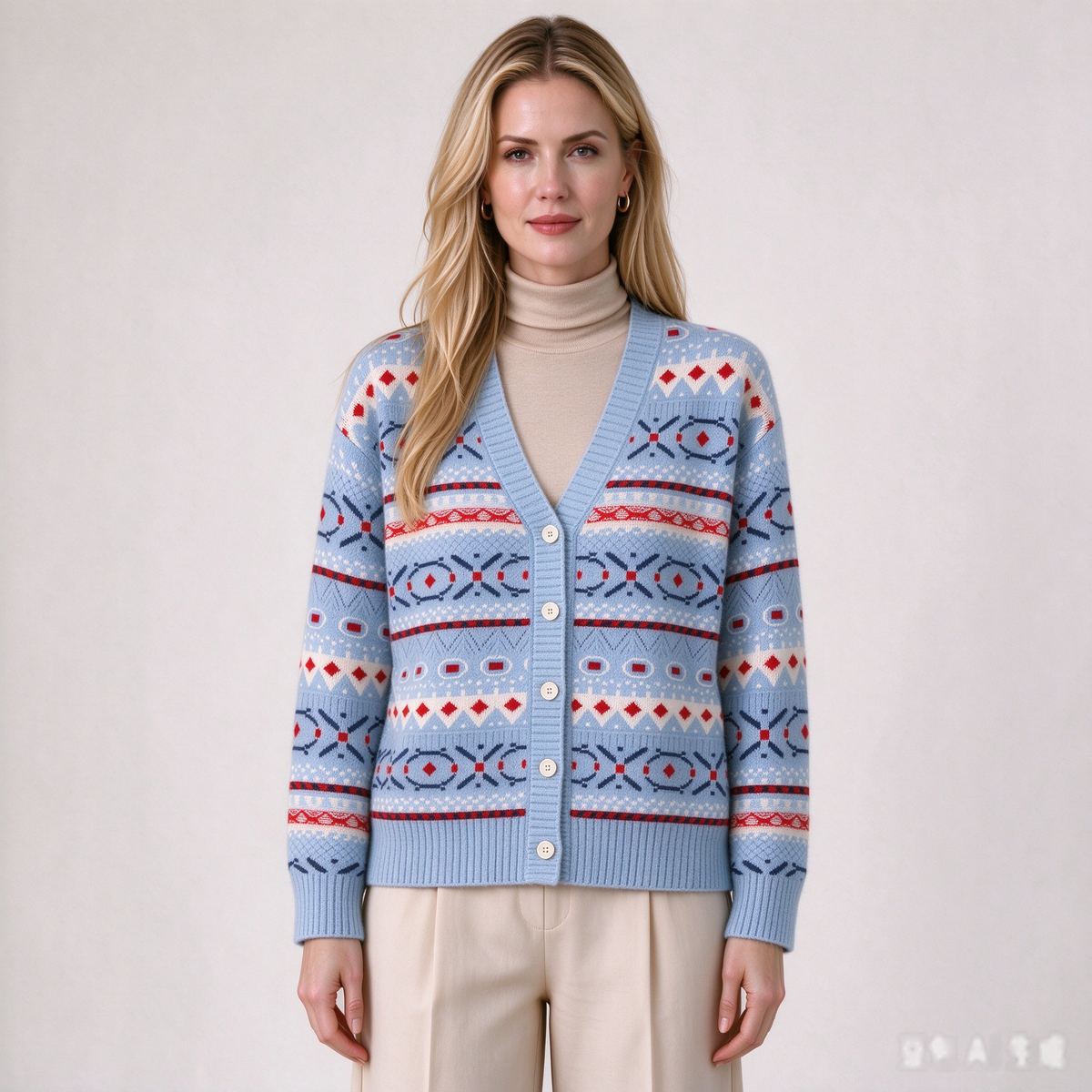
Style QM9023 — 100% merino wool, 7GG, 613 g at size M, the heaviest piece in the patterned range.
Two of them name a technique. One names a shape. That mismatch is where tech packs go wrong.
Jacquard means the machine selects needles individually, course by course, to build a design. That is the mechanism. What the reverse of the fabric looks like depends on whether the machine has one needle bed or two.
Single-bed jacquard leaves the unused colours floating across the back, and you can see them. Double-bed jacquard traps those floats between two fabric layers, so neither face shows a float. Both are called jacquard. They are not the same product, and they do not cost the same.
Fair Isle comes from Shetland. The working definition is narrower than most buyers expect: no more than two colours in any single row. A whole garment can carry a dozen shades, but never two at once in the same course.
The small repeating motifs are called peeries. Where you put them is a separate decision, and a commercial one: all-over, yoke only, or a single chest band. Fair Isle knitted into a circular yoke is the most familiar modern placement, but the yoke is a position, not a definition.
How the second colour travels is a third decision, and it is the one buyers miss. On a single bed it floats across the reverse. On a double bed it is trapped between two layers. All four Fair Isle styles on this page are knitted on double-bed machines, so their reverse is a plain back rather than a stripe of floats.
Argyle is the diamond motif, and the word describes what the pattern looks like rather than how it was knitted. The same diamonds can be built two ways, and the choice changes the garment more than the drawing does.
As intarsia, each colour block has its own yarn carrier. Nothing floats, the reverse is clean, and the fabric stays light. On a double bed, the unused colour is trapped between layers, which makes a warmer and denser piece with a plain back. Two of the four argyle styles here are intarsia; the other two are double-bed.
This is the table worth putting in front of your designer before the artwork is finalised.
| Route | How colour is placed | Reverse | Fabric | Machine time |
|---|---|---|---|---|
| Stranded jacquard, single bed | Needle selection; unused colours carried behind | Floats visible | Single layer | Baseline |
| Jacquard, double bed | Needle selection on two beds; colours linked | No floats on either face | Two layers, reversible | Higher |
| Fair Isle, stranded on one bed | Two colours per row maximum, short floats | Floats, usually in a striped rhythm | Single layer, denser | Slightly above baseline |
| Intarsia | One yarn carrier per colour block; nothing crosses | Clean, mirror of the face | Single layer, lightest | Slowest — every colour change moves a carrier |
Machine time is the honest way to compare cost, because that is what you are paying for. Yarn consumption also rises wherever floats are carried, and it rises most on all-over stranded patterns.
These are construction routes, not product categories. Fair Isle is a pattern and can be knitted on the double-bed route as well. All four Fair Isle styles in this range are, which is why their reverse is a plain back.
If your tech pack names one thing beyond the artwork, make it this.
Grouped by collection, with the construction each style is knitted on. Quote a style number and we can pull the sample.
| Style | Composition | Gauge | Construction | Weight | Size | Indicative FOB |
|---|---|---|---|---|---|---|
| FS009 | 74% polyester · 18% polyamide · 7% wool · 1% elastane | 5GG | Double-bed jacquard | 390 g | S | USD 7.0+ |
| HY002 | 65% polyester · 15% nylon · 13% viscose · 6% wool · 1% elastane | 5GG | Double-bed jacquard | 580 g | M | USD 8.0+ |
| P26W6290 | 5% mohair · 10% wool · 25% nylon · 27% acrylic · 28% polyester · 5% elastane | 5GG | Double-bed jacquard | 350 g | S | USD 9.0+ |
| P27W5040M2 | 95% polyester · 2% nylon · 2% wool · 1% elastane | 5GG | Double-bed jacquard | 395 g | S | USD 5.0+ |
| Style | Composition | Gauge | Construction | Weight | Size | Indicative FOB |
|---|---|---|---|---|---|---|
| QM9023 | 100% merino wool | 7GG | Double-bed jacquard | 613 g | M | USD 25.0+ |
| P27W5016M1 | 50% viscose · 28% polyester · 22% nylon | 12GG | Double-bed jacquard | 310 g | S | USD 5.0+ |
| 69040ZR | 88% polyester · 3% acrylic · 3% nylon · 3% wool · 3% elastane | 7GG | Double-bed jacquard | 425 g | S | USD 5.0+ |
| P27W5004M2 | 95% polyester · 2% nylon · 2% wool · 1% elastane | 5GG | Double-bed jacquard | 445 g | S | USD 5.0+ |
| P27W5025M1 | 94% polyester · 3% acrylic · 1% wool · 2% elastane | 7GG | Double-bed jacquard | 390 g | S | USD 5.0+ |
| P27W5053M1 | 100% acrylic | 5GG | Double-bed jacquard | 425 g | S | USD 5.0+ |
| P27W5059M1 | 100% acrylic | 7GG | Double-bed jacquard | 415 g | S | USD 5.0+ |
| Style | Composition | Gauge | Construction | Weight | Size | Indicative FOB |
|---|---|---|---|---|---|---|
| QM926 | 100% merino wool | 12GG | Intarsia | 223 g | M | USD 21.0+ |
| HY019 | 98% polyester · 2% elastane | 7GG | Intarsia | 205 g | S | USD 6.0+ |
| P26W4145PP | 88% polyester · 3% acrylic · 3% nylon · 3% wool · 3% elastane | 7GG | Double-bed jacquard | 395 g | S | USD 5.0+ |
| P27W5078PP | 94% polyester · 3% acrylic · 1% wool · 2% elastane | 7GG | Double-bed jacquard | 445 g | S | USD 5.0+ |
Prices are indicative FOB per piece, before negotiation, and assume 200 pieces per colour. FOB Shanghai or Qingdao; CIF on request. Composition is given as knitted. Two of the fifteen, QM9023 and QM926, are also listed on the merino wool page, because they are patterned and merino at the same time. Construction tells you how the fabric is made, not what the pattern is called. Thirteen styles are double-bed jacquard, so the floats sit between two layers and the reverse is a plain back. HY019 and QM926 are intarsia: one yarn carrier per colour block, with nothing crossing the back.
Worth stating, because briefs regularly arrive as screen-print artwork.
Gauge decides how fine the pattern can go. A 12GG panel holds detail that a 5GG chunky cannot, and no amount of artwork resolution changes that.
Related, not identical. Jacquard is the broad term for machine patterning: needles are selected individually, course by course, to build a design. Fair Isle is one tradition inside that family — stranded colourwork from Shetland, with no more than two colours in any single row. All Fair Isle is jacquard-knitted on a machine. Not all jacquard is Fair Isle.
Argyle is the diamond motif. The word describes the shape, not the technique. The same diamonds can be knitted two ways. As intarsia, each colour block has its own carrier and nothing floats across the reverse. On a double bed, the unused colour is trapped between two layers and the reverse is a plain back. Intarsia gives a lighter piece; double-bed jacquard gives a warmer, denser and reversible one. Of the four argyle styles here, two are intarsia (HY019, QM926) and two are double-bed jacquard.
On stranded work we keep floats to about five to seven stitches, which at 7GG is roughly 1.5 to 2.5 cm. Longer floats snag and distort the face of the fabric. Where a design demands a longer run, the standard answers are to break the motif or add a tie-in point. If no float is acceptable at all, the panel moves to intarsia.
Because the machine moves more. In intarsia every colour block needs its own yarn carrier, and each time the design crosses into another block, one carrier leaves and another arrives. On jacquard the needle selection does the work and the yarns simply float behind. The extra machine time is where the cost sits.
Yes, and for a first patterned range it is the cheaper route. Pattern on the yoke only leaves the body and sleeves plain, so less yarn is carried and fewer courses need checking. All-over pattern carries floats through every course, which adds yarn weight at the shoulders and upper sleeve — where a wearer feels it first.
Fifteen at the time of writing: four Fair Isle, seven jacquard and four argyle. Gauge runs from 5GG to 12GG, piece weight from 205 g to 613 g, and indicative FOB from USD 5 to USD 25 depending on yarn and gauge. Thirteen of the fifteen are knitted as double-bed jacquard; HY019 and QM926 are intarsia. All fifteen are listed above with their composition, construction and weight.
Sampling takes 7–14 days, though patterned work usually sits at the longer end because colour registration is checked against the artwork. Bulk is 45–60 days from order confirmation and sample approval, up to 75 days in peak season, August to October.
Not sure which one your design suits? Include your target price and we will tell you which route it can be knitted on. That answer usually arrives before the quote does.
Contact Us