Cable Knit Sweaters, and What the Twist Actually Costs

A cable is a stitch technique, not a fibre. Any yarn can carry one, and the yarn decides how the cable behaves.

Eight cable styles run from 3.5GG to 7GG, 295 g to 760 g, USD 5 to USD 9 FOB. Two are cotton and acrylic, two are pure acrylic, four are polyester-led. The composition of every one is in the table, because a heavy cable sweater is not automatically a wool sweater.
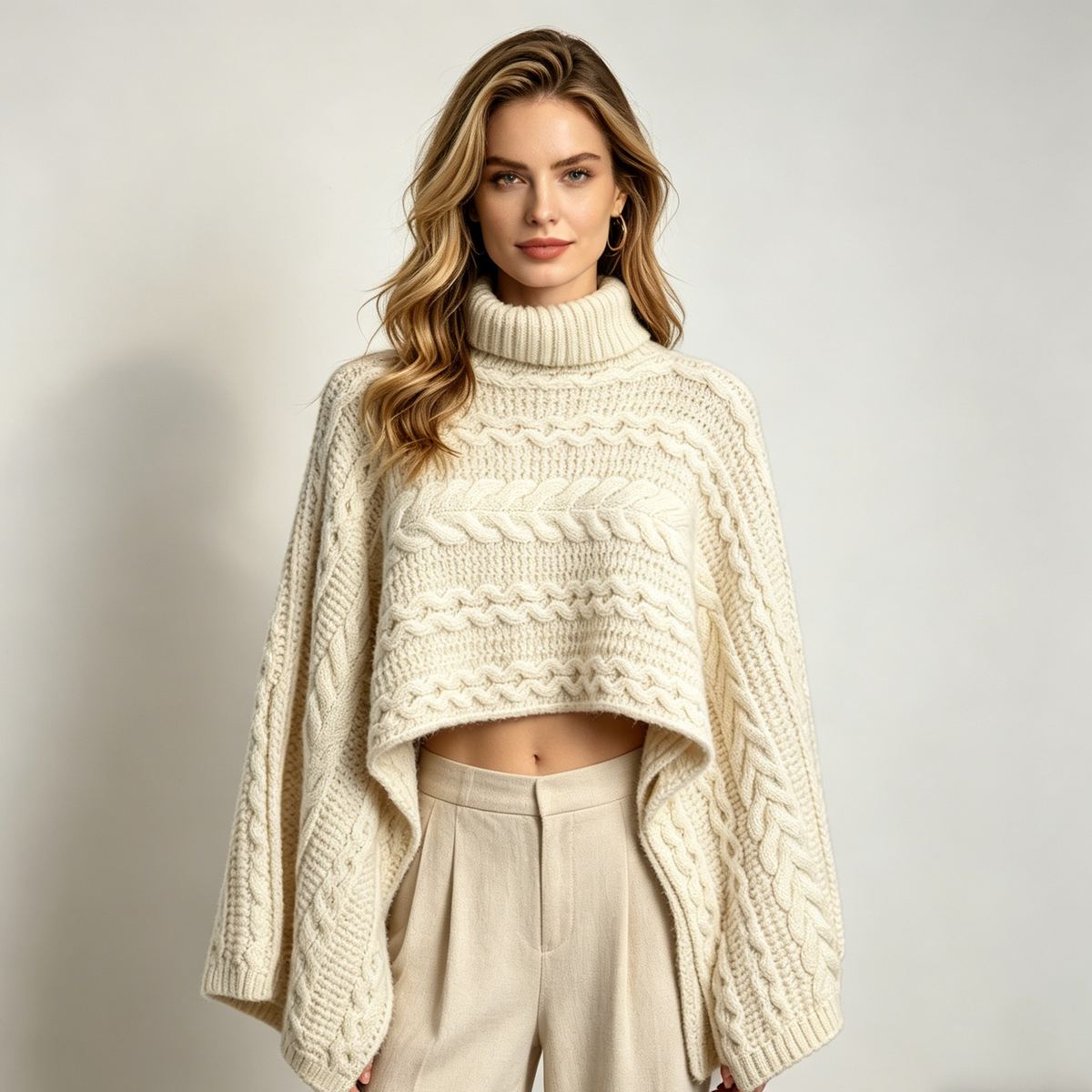
Heavy cable knit sweater in 100% acrylic, SOFTEX style 6E046BS, 760 g at size S in 5 gauge

Style 6E046BS — 100% acrylic, 5GG, 760 g at size S. The heaviest cable piece in the range.

3.5–7
GG, cable
295–760
Grams, size S
5–9
USD FOB
200
Pieces per colour

A cable is a reordering of stitches

Not a print, not an embroidery, not a thicker yarn. The loops themselves swap places.

Four stitches sit on the needle in the order A, B, C, D. A cable crosses the first pair over the second, so the next courses read C, D, A, B. Hold the first pair to the front and the rope leans left. Hold it to the back and it leans right.

On a flat machine this is a stitch transfer. Needles hand their loops to neighbouring needles before knitting continues. That transfer is the cost story on this page. A transfer is not a knit cycle, so a cable runs slower than a plain knit at the same gauge.

Three numbers define any cable, and they belong in the tech pack

Parameter What it decides Effect of increasing it
Width — how many stitches cross How wide the rope reads across the panel A wider rope, more yarn per crossing, fewer repeats across the body
Depth — courses between crossings How long and how steep the rope looks A longer, flatter rope; fewer transfers, so the machine runs faster
Background stitch How far the cable stands proud of the surface Reverse stocking behind a cable pushes it forward; plain background lets it sink

Depth is the parameter buyers most often leave out, and it is the one that changes the quote. Two cables of the same width can differ by a third of the machine time depending on how many courses run between crossings.

Where the extra money goes

A cable sweater costs more than a plain one at the same fibre and the same gauge. Three things cause that, and a design fee is not one of them.

+20–40%

Yarn, at mid gauge

Crossings pull the panel narrower, so more yarn is needed to reach the same body width. On chunky cable work the figure runs to +40–60%.

+20–50%

Machine time

Each crossing is a transfer. A dense cable panel spends a large share of its cycles moving loops rather than knitting them.

Wider

Knitted width

The panel is knitted wider than the finished measurement, then washed and measured, because a cable narrows as it relaxes.

The detail that catches people out at the fitting

Cable is denser and less elastic across the width than the plain knit beside it. Where a garment changes stitch, the needle count has to change with it. A cable body running into a rib cuff is the usual example.

If the count stays the same, the rib is knitted at the cable's tighter width and the cuff no longer grips. The same thing happens in reverse at a hem: the plainer fabric flares out because it wants more width per stitch.

We set the needle counts at both ends of every cable panel before sampling, and check the cuff on the washed sample rather than on the machine.

Cable knit is not the same word as Aran

Listings use the two interchangeably. They describe different things, and the difference shows up in what a buyer should expect.

Cable knit — one technique

Groups of stitches cross at set intervals and form a raised rope. One stitch family, one repeat, clean vertical columns. It can sit on a pullover, a cardigan, a dress or a cotton summer knit.

Because it is a technique, the word tells you nothing about origin, fibre, gauge or warmth.

Aran — a regional pattern system

From the Aran Islands off the west coast of Ireland. An Aran garment combines four or five stitch families on one surface: cable, diamond, honeycomb, basket and moss. They sit in panels, usually with a central cable flanked by the others.

Four or five stitch families in one surface also means more yarn than a plain cable repeat at the same weight.

So what do we call these eight styles?

Cable knit, and nothing more. Our range data records the composition, gauge and weight of each piece; it does not record which stitch families a given style combines. Calling one of them an Aran would mean asserting a panel layout we cannot point to.

If your brief is a full Aran panel layout, send the artwork. We will price it as the multi-stitch construction it is, rather than quoting it as a single cable repeat.

One thing usually printed about Aran that is not established

You will read that each stitch carries a meaning: cable for the fisherman's rope, honeycomb for hard work, diamond for wealth. Those readings are widely repeated and not supported by historical evidence. Historians of the tradition describe the patterns as growing out of craft and aesthetics. We mention it because a trade page that repeats folklore as fact is a page you stop trusting on the numbers.

Eight cable styles in production

Grouped by gauge, heaviest first inside each band. Quote a style number and we can pull the sample.

3.5GG — two styles, the boldest rope

StyleCompositionGaugeWeightSizeIndicative FOB
63025P&B86% polyester · 9% nylon · 4% wool · 1% elastane3.5GG720 gSUSD 7.0+
63041ZR57% acrylic · 31% polyester · 9% wool · 3% elastane3.5GG500 gSUSD 9.0+

5GG — four styles, the commercial middle

StyleCompositionGaugeWeightSizeIndicative FOB
6E046BS100% acrylic5GG760 gSUSD 8.0+
63012BS60% cotton · 40% acrylic5GG520 gSUSD 7.0+
P27W5044M170% polyester · 30% acrylic5GG450 gSUSD 5.0+
P27W6108100% acrylic5GG295 gSUSD 5.0+

7GG — two styles, cable under a coat

StyleCompositionGaugeWeightSizeIndicative FOB
P27W5103M157% polyester · 34% acrylic · 9% nylon7GG370 gSUSD 5.0+
P27S5007SS60% cotton · 40% acrylic7GG350 gSUSD 5.0+

Prices are indicative FOB per piece, before negotiation, and assume 200 pieces per colour. FOB Shanghai or Qingdao; CIF on request. Composition is given as knitted. Gauge bands are not interchangeable: 3.5GG work goes to the factory set up for that band, and 7GG work to the one set up for that.

Which yarn holds a cable

The fibre does not decide whether you can have a cable. It decides whether the cable keeps its edge, and how the piece wears.

Cotton and cotton blends

The cable edge reads cleanly and the fabric has weight, so the rope sits down rather than standing up. Good for a transitional or spring piece.

Two styles here are 60% cotton and 40% acrylic, in 5GG and 7GG.

Acrylic

Holds shape well and takes a bold cable at low cost. Soft acrylic with a loose twist is the combination that pills, so the yarn twist matters more than the fibre headline.

Two styles here are 100% acrylic, at 760 g and 295 g.

Polyester-led blends

Lighter per cubic centimetre and cheaper, so the cable's depth has to come from gauge and panel design rather than from the yarn's own loft.

Four styles here are polyester-led, one of them with 4% wool in the blend.

Fibre content is not a quality ranking in either direction. A 3.5GG acrylic cable can read deeper than a 7GG wool one, because gauge and depth decide the shadow line. What changes with fibre is how the piece wears and how it is laundered.

Lead times, minimums and payment

Sampling
7–14 days from approved tech pack. Samples are provided free of charge, but the courier cost is borne by the customer.
Bulk production
45–60 days from order confirmation and sample approval. Up to 75 days in peak season, August to October — book two to three months ahead if your delivery lands there.
Minimum order
200 pieces per colour on stock shades; 1,000 pieces per colour for yarn dyed to your Pantone reference. Lower trial quantities are possible at a higher per-piece price.
Payment
T/T 30% deposit, 70% against B/L copy, or L/C at sight. For long-standing customers with a good payment record, we can also offer T/T 30, 60 or 90 days from B/L date, at a correspondingly adjusted price.
Price basis
Prices are quoted FOB Shanghai or Qingdao; CIF on request.
Inspection
Pre-shipment inspection at 80% packing, against the approved sample.

Certificate numbers and the full qualification list are on the About page; the certificate files are sent on request.

Cable knit questions

Is cable knit the same as Aran?

No. Cable knit is one stitch technique: groups of stitches cross at set intervals and form a raised rope. Aran is a regional tradition from the islands off the west coast of Ireland. An Aran garment combines four or five stitch families on one surface: cable, diamond, honeycomb, basket and moss, arranged in panels. A sweater with one cable down the front is a cable knit, not an Aran. We call the styles on this page cable knit for that reason: our range data does not record which stitch families each piece combines.

Are these wool cable sweaters?

No, and none of the eight is wool-led. Two are 60% cotton and 40% acrylic, two are pure acrylic, and four are polyester-led. Wool appears at 4% and 9% in two of them, as a hand modifier rather than a performance claim. The composition of every style is in the table above. If you need a wool cable, the merino page lists eleven styles that can be knitted with cable panels on request.

Why does a cable sweater cost more than a plain one?

Three reasons, and a design fee is not one of them. A cable consumes 20–40% more yarn at mid gauge and 40–60% more on chunky work, because crossings compress the panel width. Machine time runs 20–50% longer, because every crossing is a stitch transfer rather than a knit cycle. And the panel has to be knitted wider than the finished measurement, then washed and measured, because cable narrows as it relaxes.

Which gauge should a cable sweater be knitted in?

Gauge decides how bold the cable reads, not how good the sweater is. At 3.5GG to 5GG the rope is deep and the piece is heavy: 500 g to 760 g at size S in this range. The yarn also needs a firm twist, or the surface fuzzes. At 7GG the cable is finer and the piece lands near 350 g, which suits a sweater worn under a coat. Fine-gauge cable from 12GG upward needs a very stable yarn, or the motif flattens after washing.

Does a cable pattern shrink the garment?

It narrows the panel and lengthens it. Crossings pull stitches together, so the fabric is denser and less elastic across the width than a plain knit at the same needle count. We knit the panel wider than the finished measurement, then confirm the width after washing rather than after knitting. The same effect explains a cuff that will not grip. Rib wants more width per stitch than cable, so the needle count has to change where the stitch changes.

Can you match a cable pattern from a photograph?

A photograph shows the look, not the programme. What the machine needs is the number of stitches crossed, how many courses run between crossings, and the background stitch. Those three decide the width of the rope and how deep it sits. Send the photo together with a gauge and a target weight, and we can usually rebuild the motif. Send only the photo and the first sample becomes the conversation.

What is the minimum order for a cable knit sweater?

200 pieces per colour where a stock shade card exists for the yarn, and 1,000 pieces per colour for yarn dyed to your Pantone reference. Cable does not change the minimums. It changes yarn consumption, so the quoted price per piece moves with the cable density in your artwork.

Continue reading

Cable is one stitch family. Two neighbouring families worth reading next.

Other stitch families, and what they cost, are listed in the knowledge index.

Send the artwork, not just the word

Cable knit covers everything from one rope down the front to a full Aran panel layout. The gap between those two is most of the cost of the garment. Include a gauge and a target weight, and we will tell you what your motif costs to knit.

Contact Us